



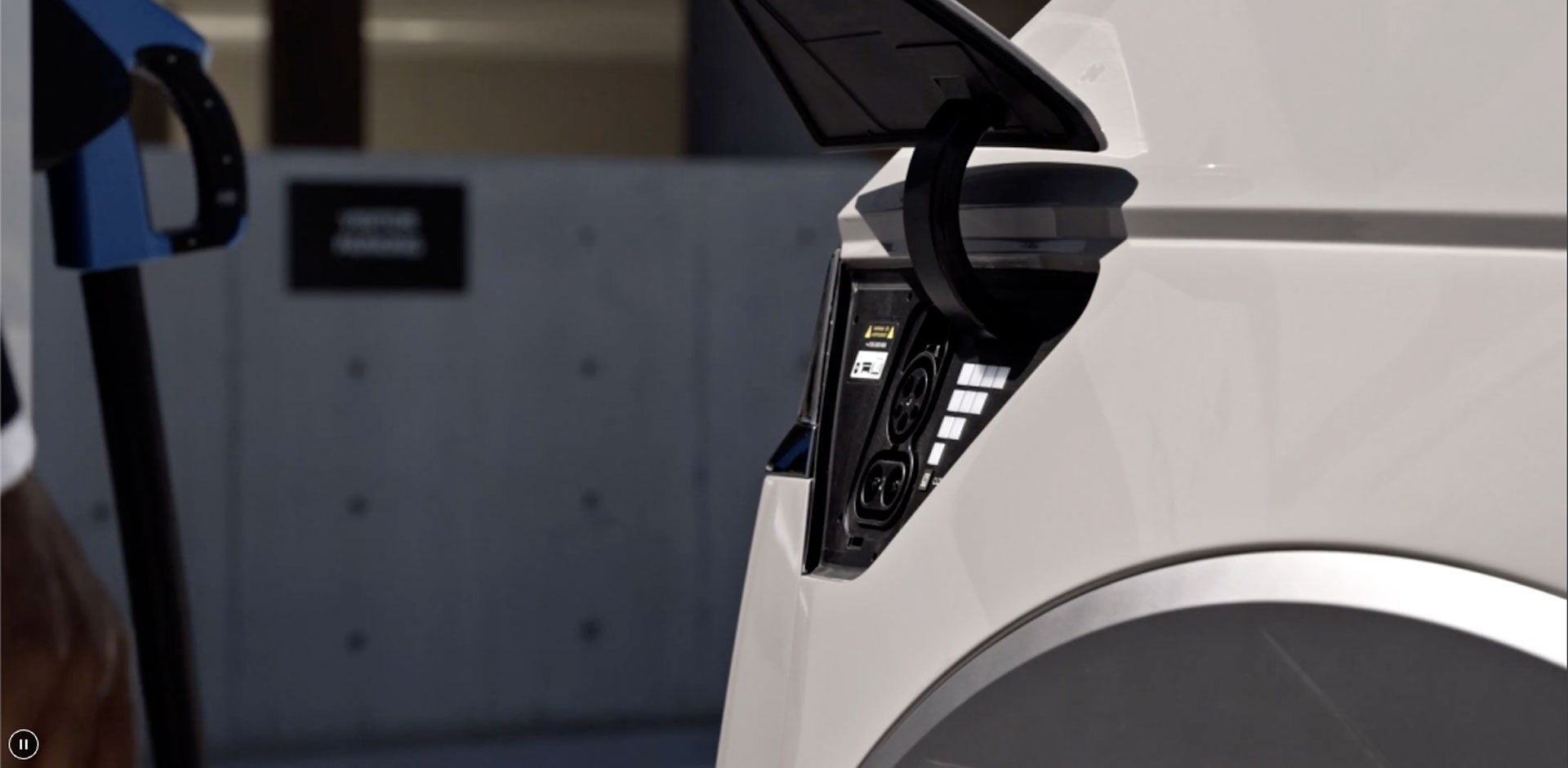
You’ve got charging questions. We’ve got answers.
With electrified vehicles you no longer have to rely on gas as the only source of power. In fact, electric and fuel cell models don’t use fossil fuel at all. Which is why two of the most important questions many shoppers ask is, “How do I keep my electrified vehicle charged?” and “How does it fit into my life?” We’re here to answer these questions and more.
What affects range

Outside temperature
As with gas vehicles, EVs are also affected by extreme temperatures. Both cold and very hot weather impact the battery’s performance, reducing range. Low temperatures also cause the tire pressure to drop, which means more rolling resistance.
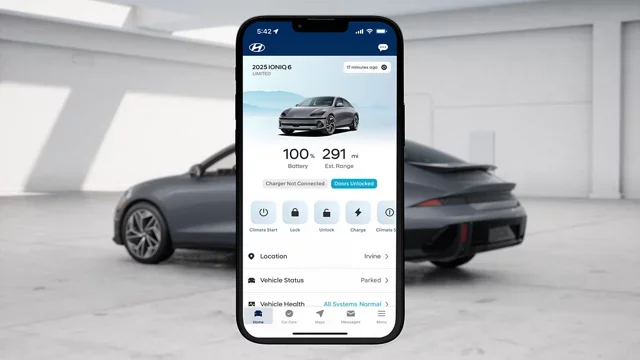
Climate control
Running the A/C, heater, or using the heated seats can drain the battery. To conserve energy, pre-heat or pre-cool your EV while plugged in, which can be done remotely with the Hyundai Bluelink app.
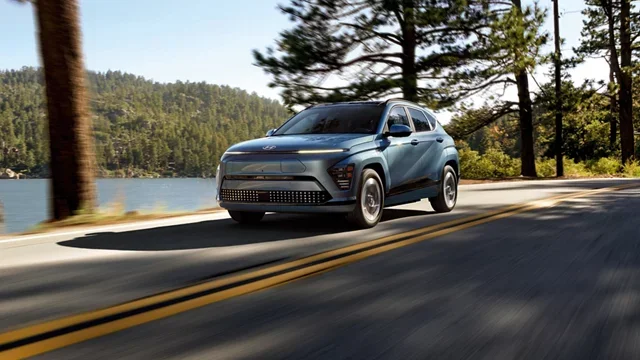
Driving style
Aggressive driving such as quick acceleration and hard braking uses up more battery power. To maximize your range, try gradually increasing your speed and anticipating stops to slow down smoothly.
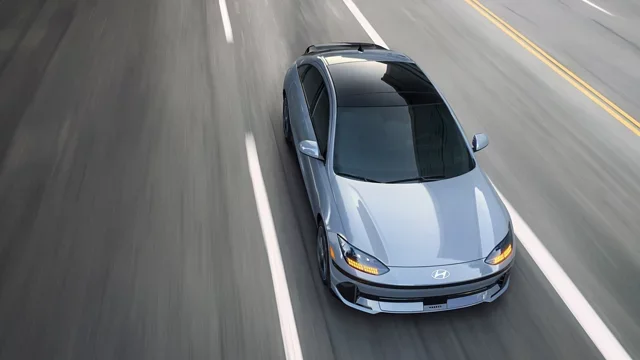
Speed
If you want to maximize range, moderate speeds are key. Higher speeds mean more wind resistance, which requires more power to compensate. This causes the motor(s) to heat up and become less efficient. Plus, the battery doesn't get as much charge back from regenerative braking.

Terrain
If your route goes through a hilly or mountainous area, your current range will drop faster than normal since driving uphill consumes more energy than traveling on level ground.
Other factors
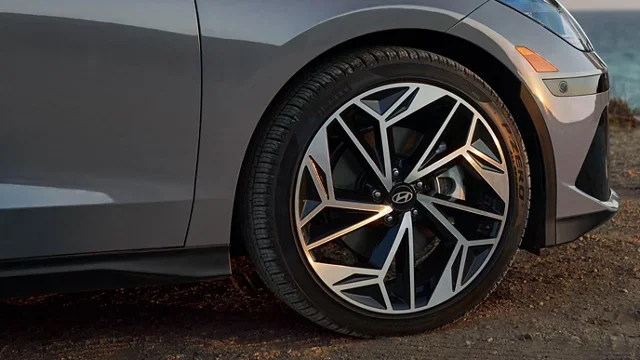
An electric vehicle’s driving range is also impacted in a number of other ways, including the weight it's carrying, the tire pressure, and battery condition.
-

Outside temperature
-

Climate control
-

Driving style
-

Speed
-

Terrain
-

Other factors
Stopping power. Literally.
When it comes to charging, regenerative braking can help extend the range of all our electrified vehicles. When you coast or brake, the brakes turn the wheels’ rotations into electricity, which is stored in the battery. IONIQ 5, IONIQ 6, KONA Electric, NEXO Fuel Cell, TUCSON Hybrid, and TUCSON Plug-in Hybrid have control paddles behind the steering wheel, which let you choose from different levels of regenerative braking.
Non-U.S. Preproduction Model Shown
Regenerative braking
High
Set to higher levels of regenerative braking, you get more energy capture when decelerating. On IONIQ 5, IONIQ 6, and KONA Electric you can use the i-Pedal function which activates the brakes when you take your foot off the accelerator, slowing to a complete stop.
Low
When you set to the lower levels of regenerative braking, you capture less energy but get longer, smoother coasting when you take your foot off the accelerator pedal.
Smart?
Activate the Smart Regeneration System, and it automatically adjusts the regenerative braking level according to the speed and distance of the vehicle in front of you.
MPGe
What’s MPGe, exactly?
Making the switch from a gas to an electrified vehicle is a big decision. One great reason to go electric is lower overall energy costs. To make it easier to compare electric with gas models, the EPA created MPGe which stands for “miles per gallon of gasoline-equivalent.”
Simply put, MPGe is the distance an EV can travel on 33.7 kWh of electricity, which is the energy equivalent of one gallon of gas.
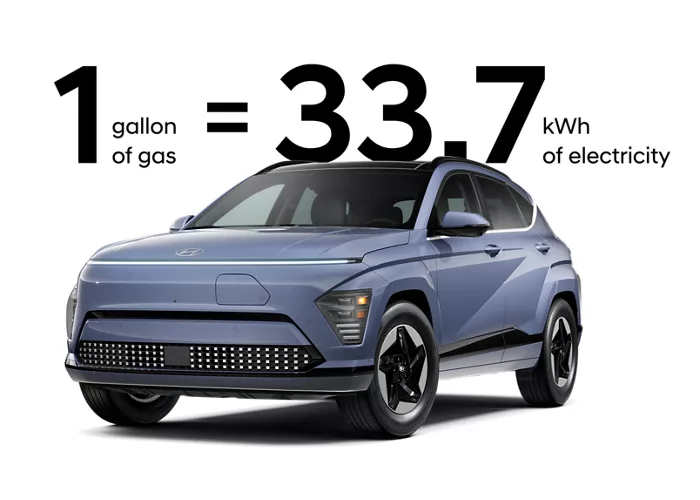
As an example, here’s a comparison between the 2025 KONA Electric and our gas-powered KONA:
Range?
2025 KONA Electric SE: 118 MPGe (EPA-est.)
2025 KONA SE (gas): Up to 31 MPG (combined)
Cost to travel 100 miles
2025 KONA Electric SE: $4.00 (at $0.14 per kWh)
2025 KONA SE (gas): $10.01 (at $3.10 per gallon)
You can also use MPGe to compare different types of electrified vehicles. For instance, 2025 IONIQ 5 SE Standard Range RWD has 114 Combined MPGe while 2025 TUCSON Plug-in Hybrid has 77 Combined MPGe.
Charging your Hyundai
Charger types
At home or on the go.
If you’re considering an EV or a plug-in hybrid, it’s important to understand the different types of chargers out there and how long each takes to power up your vehicle.


Getting charged has never been easier.
With DC fast-charging available across the country through the ChargePoint and IONNA networks, you can feel confident there’s always power ahead.
Charging convenience
Charging on the go that puts you in charge.
Charging your Hyundai on the road just got a whole lot easier. You get access to a bigger network, including Tesla Superchargers, an all-in-one Bluelink app that manages everything, and effortless Plug & Charge that makes payment a breeze.
More places to charge your Hyundai.
Charging flexibility comes standard on your Hyundai. Not only are we providing Tesla Supercharger-compatible NACS adapters for our current EV owners, but starting with the 2025 IONIQ 5 and 2026 IONIQ 9, future electric models will come equipped with NACS ports standard. Which means you can now access a bigger network of 61,000 DC fast chargers across the country.
In-app charging
Our Bluelink charging app conveniently puts everything in one place. Now you can find charging stations, start charging sessions, and process payments through your smartphone.
Plug & Charge
Imagine public charging without the extra hassle of apps or cards. Simply plug in and charging starts right away. Plug & Charge takes care of authentication and payment automatically.
Powering the future of electrification.
Hyundai and IONNA are rolling out a nationwide EV charging network designed for speed and simplicity. Plug and Charge technology and renewable power make it easy to stay on the move while driving toward a cleaner future.
Learn moreEV Route Planner
Hyundai navigation systems can locate charging stations along specific routes and refresh as you go. You can also view information about each station. The EV Route Planner also tells you how many charging stops you’ll need to make, as well as expected no-charging zones. So, you’re confident and prepared on every trip.
Fuel cell charging
Protect your battery from heat
During very hot weather, shaded spots or staying plugged in when parked help your vehicle’s thermal management system run more efficiently.
Ideal charging range
A 100% charge is there when you need it, but the optimal range for better battery life is between 25% and 75%.
Standard chargers
While DC fast chargers are great for road trips and saving time, for everyday charging, standard chargers are much better for your battery’s long-term health.
Timed chargers
Going on vacation? A timed charger helps keep your battery at an ideal charge level between 25-75% while you’re away.
Going electric with Hyundai.
Hyundai Home
Make your house as electrified as your electric vehicle. With Hyundai Home, you’ll have the power to take charge of your electricity with solar panels, energy storage systems and a 240-volt (Level 2) charger.
Learn moreFAQ
Got questions?
The actual charging time varies based on a number of factors, including the vehicle model and trim, current battery charge level, output of the charging unit, vehicle and battery settings, and outside temperature. Level 1 is the easiest home charging option—you simply plug into a standard 120V AC outlet with the portable charging cable that comes with select Hyundai models. But it takes significantly longer than other charging options. Level 2 charging can fully charge your vehicle in as little as 4 hours 55 minutes (2025 KONA Electric SE Standard Range) depending on the model and various conditions. For Level 3 charging, DC fast chargers can take your vehicle from 10% to 80% in as little as 18-73 minutes, depending on model. Even better, a 350-kW, 800V DC ultra-fast charger can power up 2025 IONIQ 6 from 10 to 80% in just 18 minutes.
The cost to charge an electric vehicle (EV) depends on several factors, including local electricity rates, the type of charger used, where you charge (home vs. public charging station), and the vehicle itself. To help you calculate your possible fuel savings by switching to an electric vehicle, please use our estimated savings calculator.
Not all electric vehicles use the same charger. Different charging connectors and standards are used by manufacturers and regions. To accommodate a variety of vehicles, public charging stations usually offer multiple connector types. For Level 1 charging via a standard 120V AC outlet, your Hyundai includes a Level 1 charging cable. However, a Level 2 charging cable is not included.
According to the U.S. Department of Energy, there are over 65,000 electric vehicle (EV) charging stations across the United States. Hyundai is joining seven other global automakers to build an unprecedented charging network. With BMW Group, General Motors, Honda, Kia, Mercedes-Benz Group, Stellantis NV, and Toyota—we’re installing at least 30,000 high-powered DC chargers across North America. Most importantly, our network will be open to anyone who drives electric. Learn more here.
Bowser Hyundai of Chippewa
Address
139 Mckinley Road
Beaver Falls, PA 15010
Phone
- Sales 724-506-4304724-506-4322
- Service 724-506-4305
- Parts 724-506-4296
| Monday | 9:00AM - 8:00PM |
| Tuesday | 9:00AM - 8:00PM |
| Wednesday | 9:00AM - 8:00PM |
| Thursday | 9:00AM - 8:00PM |
| Friday | 9:00AM - 6:00PM |
| Saturday | 9:00AM - 5:00PM |
| Sunday | Closed |
| Monday | 8:00AM - 5:00PM |
| Tuesday | 8:00AM - 5:00PM |
| Wednesday | 8:00AM - 5:00PM |
| Thursday | 8:00AM - 5:00PM |
| Friday | 8:00AM - 5:00PM |
| Saturday | 8:00AM - 4:00PM |
| Sunday | Closed |
| you break it we fix it | |
| Monday | 8:00AM - 5:00PM |
| Tuesday | 8:00AM - 5:00PM |
| Wednesday | 8:00AM - 5:00PM |
| Thursday | 8:00AM - 5:00PM |
| Friday | 8:00AM - 5:00PM |
| Saturday | Closed |
| Sunday | Closed |